

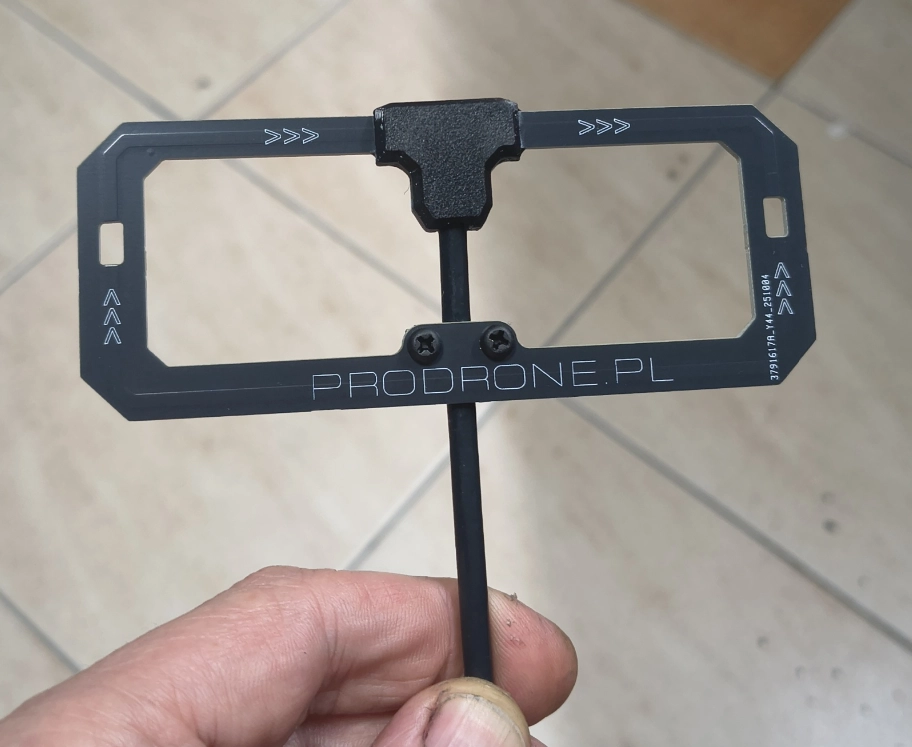
Pro Mox_R v3 868Mhz
Leave feedback on the product

High-performance Moxon antenna on FR4 PCB with 12cm RG402 cable. Each unit individually tuned on VNA for perfect 868 MHz resonance.
Specifications:
- Gain: 5.5 dBi directional
- SWR: < 1.3 @ 868 MHz
- Bandwidth: 840-920 MHz
- Coverage: >200° horizontal (vertical mount)
- Cable: 12cm RG402 semi-rigid
- Connector: SMA male
Key Benefits:
✅ 80% more range vs dipole antennas
✅ Individually tuned and tested
✅ Field-proven design through extensive prototyping
✅ Wide bandwidth
✅ Perfect for ELRS, Crossfire, Meshtastic
Shipping costs are not included in the price.
Shipping costs are not included in the price.
Select product variant
Individual variants may differ in price
Product code: 149_20251016175305
Item description
MOX_RV3 Antenna 868 MHz
Professional directional antenna for long-range RC systems
The Moxon antenna in PCB design is a proven solution for ExpressLRS, TBS Crossfire and other 868 MHz protocols. Precise manufacturing on 1.6 mm FR4 laminate with a factory-mounted RG402 cable of ~12 cm length ensures repeatable parameters and simple installation.
History and operating principle
The Moxon antenna was developed by Les Moxon (G6XN) in 1993 as a compact alternative to the Yagi antenna. The design derives from a rectangular "folded dipole" antenna and features a unique shape resembling a rectangle with bent corners. The main advantage is achieving directionality with dimensions 30% smaller than a classic Yagi with similar parameters.
The key to Moxon's operation is the precisely calculated distance between the active element and the reflector. Capacitive coupling at the element ends provides an excellent front-to-back ratio while maintaining broad characteristics in the side planes.
Real-World Engineered, Not Just Calculated
This antenna is the result of extensive R&D with multiple prototype iterations and real-world testing. Unlike many antennas on the market that exist only as theoretical calculations or untested simulations, our Moxon has been refined through:
- 7+ prototype versions tested in actual flight conditions
- Field validation with ELRS and Crossfire systems
- Range testing at various power levels and environments
- SWR and impedance optimization
Theory meets reality: what works in simulation doesn't always perform in the field. Every dimension and detail has been validated through actual use, not just software predictions.
Technical specifications
Electrical parameters:
- Center frequency: exactly 868 MHz
- Operating band: 840-920 MHz (SWR < 1.5)
- Impedance: 50 Ω
- SWR at band center: < 1.1
- Return Loss: > 17 dB
- Gain: 5.5 dBi (main direction)
- Front-to-back ratio: > 12 dB
Radiation pattern:
The Moxon antenna has an interesting property, very wide coverage in the plane perpendicular to the main direction:
| Orientation | Horizontal coverage | Vertical coverage | Best application |
|---|---|---|---|
| Vertical | ~220° (at -3dB) | ~70° | Wide sector coverage |
| Horizontal | ~70° | ~220° (at -3dB) | Flights at various altitudes |
| Angled 45° | ~120° | ~120° | Universal |
This wide pattern (>200° in one plane) makes the Moxon excellent for maneuvering drones while maintaining directional gain and rear signal suppression.
Mechanical parameters:
- Material: FR4 laminate 1.6 mm
- Copper thickness: 35 μm
- Cable: RG402 semi-rigid, length about 12 cm
- Connector: SMA male (RP-SMA available)
- Dimensions: 98 x 42 mm
- Weight: 55 g with cable
Why 12 cm cable?
This length minimizes interaction between the antenna and the transmitting device: the antenna's near field doesn't reach the transmitter electronics. Result: stable parameters regardless of enclosure type or mounting, no impedance detuning and maximum power transfer.
PCB construction advantages
Production repeatability
PCB technology ensures tight dimensional tolerances. Every manufactured antenna has identical parameters, with no "lottery" effect known from hand-made antennas. This is particularly important for the Moxon geometry, where precise spacing between elements is critical.
But we don't stop there! Each antenna is individually tested and fine-tuned on a professional vector network analyzer. We verify and, where needed, adjust every piece to achieve perfect resonance at 868 MHz. You receive not just a good antenna, not just an adequate antenna, but a perfectly tuned antenna. This individual attention to each unit guarantees that you receive equipment with parameters matching or exceeding the specifications.
Losses and bandwidth
Bandwidth >80 MHz results partly from small losses in the FR4 laminate, which "flatten" the SWR curve. Disadvantage or advantage? In practice, an advantage: the antenna remains well matched over a wide range of temperatures and humidity and tolerates nearby obstacles.
Mechanical stability
Our proprietary cable mounting solution ensures exceptional durability of the critical connection point. The RG402 cable is attached using a reinforced soldering technique with additional mechanical strain relief, making the antenna truly robust. The rigid PCB structure doesn't change geometry under wind or vibration: no bent elements, no detuning. This combination of solid PCB construction and reinforced cable attachment creates an antenna that maintains stable parameters over years of use, even in demanding field conditions.
Practical applications
ExpressLRS / Crossfire
An ideal choice for ground stations and transmitter modules. 5.5 dBi gain means an approximately 3.5x stronger signal in the flight direction compared to an omnidirectional antenna. In practice, this translates to a 60-80% range increase at the same power.
Diversity systems
Excellent as the directional antenna in a diversity setup with an omnidirectional antenna. The wide pattern (>200°) ensures smooth switching between antennas without dead zones.
Meshtastic
For point-to-point links between nodes. Directionality allows stable long-distance connections while keeping power consumption low.
Tracking
Mounting on a tracker makes full use of the antenna's potential. The wide pattern makes it easier to "catch" the drone after takeoff.
LoRaWAN
It works very well in LoRaWAN applications for Smart City, industrial monitoring, telemetry systems and building automation. The directional radiation pattern increases link range while reducing interference from the sides.
Comparison with other antenna types
| Parameter | Moxon PCB | Yagi 3el | Dipole | Patch |
|---|---|---|---|---|
| Gain | 5.5 dBi | 6-7 dBi | 2.15 dBi | 8-9 dBi |
| Size | Small | Large | Very small | Medium |
| Coverage angle | >200°/70° | 60°/60° | 360°/80° | 60°/60° |
| Mechanical strength | High | Low | High | Medium |
| Price/performance | Very good | Good | Low | Medium |
Installation tips
- Orientation: For typical FPV applications, mount vertically (matching drone antenna polarization)
- Height: Every meter of mounting height can add kilometers of range
- Direction: Front of the antenna (side without reflector) towards the flight direction
- Clearance: Minimum 30 cm from large metal surfaces
RG402 cable technical data
- Impedance: 50 Ω
- Loss at 868 MHz: ~0.3 dB/m (at 12 cm: only 0.036 dB!)
- Outer diameter: 4.5 mm
- Minimum bend radius: 5 mm
Package contents
- Moxon PCB antenna with soldered RG402 cable
- SWR measurement label
Warranty and certificates
24 months manufacturer warranty. Each antenna tested on vector analyzer.
Fun fact: Les Moxon originally designed his antenna for HF (shortwave) bands, where a 30% size reduction meant the difference between a 20-meter and a 14-meter antenna. Today his design is used from MHz to GHz: from marine communications to Wi-Fi and drones.
This antenna can be used with any system that works in the 868,900,915 MHz bands (FrSky, TBS, Radiomaster, iFlight, Wi-Fi routers, ExpressLRS, BetaFPV, Orqa, etc.) and has an antenna connector or can be modified to use an external antenna.
The color of printed parts may change without prior notice. A color change does not affect antenna performance.
Before mounting the antenna, please read:
https://shop.prodrone.pl/czeste-pytania
Product Reviews
If you've added a review and it doesn't appear on the list, it may be pending moderation.
Leave feedback on the product
Stwórz stylizację
-
Price 40,00 złPrice 32,52 złwithout VAT
-
Promotional price 21,00 złLowest price: 25,00 zł-16%Price 17,07 złwithout VAT
-
Price 35,00 złPrice 28,46 złwithout VAT


